
Wednesday, February 27, 2019
More Questions Raised for Atlas 5Y3591 Loss of Control
Atlas 767 flight 5Y3951 was descending for 3,000 feet when it appears to have briefly leveled off at 6,200 feet, before nosing over and plunging to the ground.


Sunday, February 24, 2019
NTSB Brief Atlas 5Y3591 Sun 4pm CST
NTSB chairman Sumwalt has seen video of the last five seconds to the impact of Atlas 5Y3591 and confirms it was in a steep, wings-level dive and made no visible attempt to pull up. The debris field is approximately 200 yards long by 100 yards wide in a NW orientation, consistent with the aircraft steep trajectory and high speed. The steep descent began with light to heavy rain in the area, from about 6,000 feet at 240 knots airspeed. There was no communication from the flight crew after their routine approach. They were descending from 18,000 feet for 3.000 feet when the event occurred.
Saturday, February 23, 2019
Atlas Air 767 Flight 5Y3591 Plunges from 6,000 Feet

Three Atlas Air crew members tragically perished when their 26 year-old Boeing 767 plunged from about 6,000 feet in about 10 seconds. The freighter had departed from Miami and was on approach to Houston (IAH). The crew made no radio call, and there was no warning or indication of difficulty prior to the pitch over.
Friday, December 7, 2018
Stopping Distance
Runway factors change the normal stopping distance of a Boeing 737-700.
- A 10 knot tailwind adds about 21% to the stopping distance
- A wet runway adds about 15% to the stopping distance
- Standing water can more than double stopping distance.
Southwest WN278 overran the KBUR (Bob Hope, Burbank, BUR) runway 08. The Boeing 737-700 rolled into the Engineered Material Arrest System (EMAS) that had been installed as a result of another Southwest 737-300 which overran the same runway in March 2000. This was the second airplane to be fortunate for arrestment by that particular EMAS installation.
Lateral approach path shows a correction right-to-left on short final, which may have led to running off the left side of the runway. The last recorded speed of 49 knots at the runway end, after a normal arrival point, and expected touchdown point (assuming appropriate landing weight), leaves standing water/hydroplaning as the most likely overrun villain. There is no data to confirm the reason for lack of deceleration and control; only data to show it did not (which is evident in its final resting position). The nose-gear entered the EMAS probably traveling between 35 and 40 knots.
Lateral approach path shows a correction right-to-left on short final, which may have led to running off the left side of the runway. The last recorded speed of 49 knots at the runway end, after a normal arrival point, and expected touchdown point (assuming appropriate landing weight), leaves standing water/hydroplaning as the most likely overrun villain. There is no data to confirm the reason for lack of deceleration and control; only data to show it did not (which is evident in its final resting position). The nose-gear entered the EMAS probably traveling between 35 and 40 knots.

Aviation safety initiatives demand improvements to limit recurrence of the same factors that cause an accident or injury. While two Southwest 737s have overrun the same runway, this time EMAS brought the Southwest airliner to a rapid stop without significant injury.
Sunday, December 2, 2018
Angle of Attack Vane Failure Modes
Lion Air JT610 Captain's angle of attack (AoA) measurement was about 20 degrees higher that the First Officer's AoA. The excessively high AoA value caused considerable flight deck effects, which may have been a principal factor in the catastrophe. Electrical and mechanical malfunction characteristics of the AoA transmitter are matched against observations. The most likely failure is mechanical in nature, influenced by air pressure, and fully internal to the AoA transmitter.
 |
UTC Aerospace Systems (Rosemount) Model 0861 AoA Transmitter
|
Friday, November 23, 2018
First Look at JT610 Flight Data
Partial release of flight data from JT610 (h/t to Don Thompson). In short summary, the left Angle of Attack (AoA) vane was substantially offset from the right vane from taxi out. The left stick shaker activated on liftoff and stayed on for most of the accident flight. MCAS trimmed nose down when flaps were up. In a deadly game of tag, the Pilot stopped MCAS by manual trim nose up, but MCAS would start again five seconds later. In each excursion, the stabilizer was held roughly in trim. There are 26 occurrences of MCAS trim down, pilot trim up.
It may have been the point when the captain transferred control to the first officer that MCAS was successful in two successive cycles, trimming the stabilizer nose down over four units without opposition.
The captain seems to have taken control back in the end, and pulls the column hard aft. MCAS is able to trim yet another one unit nose down before the captain stops it, but there is no subsequent significant command to trim stabilizer nose up. The airplane dive exceeded 450 knots by the point of impact.
The captain seems to have taken control back in the end, and pulls the column hard aft. MCAS is able to trim yet another one unit nose down before the captain stops it, but there is no subsequent significant command to trim stabilizer nose up. The airplane dive exceeded 450 knots by the point of impact.
The prior flight showed similar behavior. But on that flight, the flight crew appear to have quickly cutout the electric trim altogether, and completed the flight trimming the stabilizer with the wheel.
Search for the CVR continues.
Search for the CVR continues.
Tuesday, November 20, 2018
737 FCC Pitch Axis Augmentation - Command Integrity Mandate for Dual Channel, Fail-Safe
A line is drawn between primary flight controls that the pilot handles directly through control column, rudder pedal, and stabilizer trim; and automatic control, such as the autopilot, which manages the same surfaces through computer command.
The Yaw Damper is an example of an automatic flight control system added to the airplane to augment flight characteristics. The Yaw Damper operates regardless whether pilot manual flight control or automatic flight control.
FCC Pitch Axis augmentation (Mach Trim, Speed Trim, and MCAS) commands may be based on a single sensor input. These commands should be checked against a calculation based on a second sensor set before becoming valid. A software update to the FCC may provide support for a dual channel mandate.
Thursday, November 15, 2018
737 MCAS - Failure is an Option
The 737MAX introduced a new feature, Maneuvering Characteristics Augmentation System (MCAS). MCAS commands the stabilizer to trim down (only while flaps are up) in steps. From reports, the aft column cutout switch is disabled while MCAS is active. MCAS commands nose down trim at 0.27 deg/sec for about 10 seconds at a time. It then pauses briefly (duration not known, but presumed five seconds). The time history of a fabricated scenario, starting at a stabilizer position of 8 units, shows it would take about 55 seconds to reach the nose-down limit. Starting at a more nose down position takes less time, e.g from 4 degrees about 35 seconds).
 |
| MCAS Commanded Stabilizer Trim Without Stopping |
Monday, November 12, 2018
Stabilizer Trim
LionAir JT610 plunged into the sea from what may have been the result of runaway stabilizer trim. The details are not released, but the FAA has issued an Airworthiness Directive drawing attention to the recovery from such an event. What is stabilizer trim and why would it runaway?
 |
| http://rgl.faa.gov/Regulatory_and_Guidance_Library/rgad.nsf/0/83ec7f95f3e5bfbd8625833e0070a070/$FILE/2018-23-51_Emergency.pdf |
Saturday, October 13, 2018
Coverage Along a Route - Europe
Airlines flying routes connecting European airports fly far enough north to limit satellite elevation to less than 45 degrees. Installing a Ku/Ka band satellite antenna in the Airbus-nominated position for A320 series creates a blockage from the tail (shadowing) that can extend more than 30 degrees in elevation and about 4 degrees wide. This combination can lead to loss of service when the airplane is flying directly away from the servicing satellite. The problem is made worse by using satellites that are not well situated.

Friday, October 12, 2018
Close Calls Coming (TG679) and Going (IX611)
ADS-B OUT data broadcast coupled with machine learning can create a great enhancement to aviation safety. Flight Operations Quality Assurance (FOQA) was conceived as an anonymous means to reveal unsafe trends. The post-flight evidence would guide training and awareness, not personal vendetta. With ADS-B, the alerting can be done in real-time; the trends recognized as they are occurring.
 |
| IX611 Takeoff normal (A) and accident (X) |
Friday, September 28, 2018
Using True Time Delay to Increase Instantaneous Bandwidth in a Phased Array Antenna
The progression towards High Throughput Satellites is enabled by frequency reuse using larger and larger bandwidth signals. Bandwidths exceeding 100 Mhz are commonplace, with 250 MHz and larger bandwidths evident. A phased-array antenna belies the concept of using phase control to form a beam (or inherently, steer the beam electronically.)

Tuesday, September 25, 2018
APEX 2018 Midway Report
APEX EXPO 2018 got started a day earlier than I expected. My report from the first two days looking at VR headsets, satcom partnerships and agreements, seeking profit, and emerging technology.
Thursday, September 20, 2018
Panasonic adds Inmarsat GX to the Routing Table
Panasonic and Inmarsat have jointly announced an agreement to work together.
- Panasonic will offer Inmarsat as their exclusive Ka-band satcom supplier
- Panasonic will continue to operate and grow their Ku-band network
- Inmarsat will be able to bundle in Panasonic IFE and support as a part of their offerings
- Panasonic and Inmarsat will jointly develop a new Inmarsat GX terminal
"Customer airlines will be able to select a product that represents the best that Inmarsat and the best that Panasonic offer together" declared Ian Dawkins, Panasonic Senior VP of Network Operations. "This is far more than a simple reseller agreement."
Thursday, June 7, 2018
Aviation Cybersecurity 101

Here is my slide deck (with notes). I have revised and added a slide to address how an iPad can host type B EFB messages.
Monday, April 30, 2018
Lion Air PK-LOO JT-892 Departed runway after touchdown
Joining final approach very late may have contributed to a Boeing 737-800 departing the runway 27 at GTO/WAMG Gorontalo Jalaluddin Airport in Indonesia at about 18:35:30L (10:35:30Z).


Monday, February 26, 2018
Seamless Air Alliance - Who Owns the Customer?
Delta, Airbus, OneWeb, Sprint, Airtel, and Gogo announced the formation of the Seamless Air Alliance.
Equipment, certification, satellite coverage, billing and overall service is included as a one-stop offering.

A participating airline picks parts from a catalog, installs per a cookie-cutter, turns it on, and the passengers connect to the Internet.
Friday, February 9, 2018
Malfunction in an Aero Ku/Ka-band Satcom System
Ku/Ka-band Satcom Systems offer no safety functions.
No failure of the satcom system should create an unsafe effect.
Users of the satcom system do so at their own peril, as they would with any Internet access provider.
Discovery of cybersecurity vulnerabilities should emphasize rapid response to close the threat and a cooperative approach to sharing information privately, with an agreement to share enough information publicly to raise awareness of best practices.
Details and a checklist in the following paper.

No failure of the satcom system should create an unsafe effect.
Users of the satcom system do so at their own peril, as they would with any Internet access provider.
Discovery of cybersecurity vulnerabilities should emphasize rapid response to close the threat and a cooperative approach to sharing information privately, with an agreement to share enough information publicly to raise awareness of best practices.
Details and a checklist in the following paper.
Sunday, January 28, 2018
PP792 Mark 2 Satcom Advanced Features
PP792 defines the form and fit characteristics of the Mark II Aviation Ku-band and Ka-band Satellite Communication (satcom) System, intended for installation in all types of commercial air transport aircraft. The satcom system described in PP792 represents the next evolution from the Mark I system defined in ARINC Characteristic 791, Part 1.
Significant advancements include:
Significant advancements include:
- Single, standard installation, no customization, fully interchangeable
- Smaller: no KRFU, Virtual APM
- Lighter: smaller connectors, fewer wires, no hyper-critical wiring, coax, or waveguide
- Flexible lug pattern accommodates two apertures, each up to 42"
- High power supply (2000 Watts) for large, solid-state, phased-array antennas
- Integrated Position, Attitude and Heading sensor
- High performance IF interface supporting NGSO networks
Sunday, January 14, 2018

Thursday, January 11, 2018
10 Years Later - Still Standardizing Aero Ku/Ka Satcom
With a two hour telecon in Jan 2008, the SAE/ITC AEEC
Ku/Ka-band Satcom Subcommittee started to work together. What ever happened?
10 years and 122 gatherings later, we are still at it! Here we are today @ThinKom_Inc.

Tuesday, January 2, 2018
Regulating Radiated Emissions
 |
| https://transition.fcc.gov/Bureaus/Engineering_Technology/Documents/bulletins/oet56/oet56e4.pdf |
Equipment installed on aircraft must be designed and tested to be compatible with other equipment and with the airborne environment. Notably, radio frequency (RF) radiated emissions from one system may disrupt other aircraft systems such as radio receivers or present hazards to human health.
Wednesday, December 6, 2017
Project Paper 792 - Dec 2017 Update
 |
| Project Paper 792 System |
Project Paper 792 provides the form and fit of these second-generation satcom systems building on the baseline from ARINC 791 part 1 and using a common functional definition using ARINC 791 part 2 and Project Paper 848.
Friday, November 17, 2017
Comparing Antenna Performance

While it is possible to get 2x as marketing touts, the ThinKom (2Ku) antenna achieves about 1.5 times the spectral efficiency as a competing 2-axis antenna along typical routes. The ThinKom antenna may perform even better in the tropics, where the elevation angles may be highest.
The ThinKom antenna can operate without any performance reduction due to skew angles that may be encountered in the tropic regions, unlike a 2-axis antenna which may suffer severe degradation.
Theoretically, these same benefits await other flat-panel antennas. Practically, no other antenna has made public, legitimate claim to a design matching instantaneous bandwidth, efficiency, robustness, and scan loss, in the same size package. VICTS weakness is cost, weight, form-factor; all of which electronic phased array may have advantage.
The ThinKom antenna can operate without any performance reduction due to skew angles that may be encountered in the tropic regions, unlike a 2-axis antenna which may suffer severe degradation.
Theoretically, these same benefits await other flat-panel antennas. Practically, no other antenna has made public, legitimate claim to a design matching instantaneous bandwidth, efficiency, robustness, and scan loss, in the same size package. VICTS weakness is cost, weight, form-factor; all of which electronic phased array may have advantage.
Monday, November 13, 2017
Defense in Depth

Defense-in-Depth is a security concept that applies successive barriers to unauthorized access. Aeronautical communication includes a Commercial-off-the-Shelf (COTS) layer, a Network layer, and an Application layer.
Friday, October 27, 2017
Space Shuttle Approach and Landing Test Program

Monday, October 23, 2017
Google Loon - Floating Nest of Radio Technologies

Google is deploying a High Altitude Platform System (HAPS) in
the form of balloons that float around 20 km in altitude above a service area. Representative link budgets for both the LTE service and the air-ground unlicensed feeder link show that one balloon can deliver about 10 Mbps uplink and 20-25 Mbps downlink, on average, to LTE subscribers in an 80 km coverage area.
Saturday, September 2, 2017
Managing Network Security and QoS: PP848
Air Transport Airplanes are faced with a monumental challenge to upgrade and embrace modern IP radio networks. Network security has risen mightily to challenge designers, mire down operations, and yet struggles to achieve its goal. Bandwidth management - Quality of Service - is done piece-meal, blind to real priority and performance goals. What will bring this all together?
Friday, September 1, 2017
“Otto”, your new First Officer
Will air transport airplanes carrying many people for commercial purposes move to fully autonomous, no human pilot onboard?
The First Officer will turn into “Otto”, a
built-in feature of the next generation air transport airplane, and that the Captain
is here to stay. This is a logical progression from four to three (no Navigator) to two (no Flight Engineer) to one (no First Officer.)
Thursday, August 31, 2017
Antenna Performance along an Airline Route
Aircraft fly from a departure airport to a destination airport along a route that is ideally a great circle connecting the two airports. Weather and other aircraft traffic, along with other considerations, can lead an airplane across a range of territory when flying the route from day to day.
Airplanes inherently favor flying wings-level while not maneuvering (as opposed to a slip.) This leads to greatest passenger satisfaction and can avoid troubling issues with fluids. As a result, the orientation of the airplane changes with respect to satellites operating along the geostationary orbit (GSO). The relative orientation between satellite and antenna leads to beam steering (azimuth, elevation, polarization skew) commands and also has an influence upon the airplane antenna performance.
 |
| Skew angle and Elevation angle from various satellite positions, flying Los Angeles to Sao Paulo, Multi-gimbal antenna |
Wednesday, August 30, 2017
Choosing an Airline Wireless Internet Service Provider (WISP)
Airlines have been providing passengers radio communication services at their seat since 1937.
In 2017, airline passengers yearn for free and compelling Wi-Fi Internet access. What should an airline consider when choosing an inflight Wireless Internet Service Provider (WISP)?
Monday, April 17, 2017
Spectral Efficiency - The Fitness of Wireless Communication

Spectral efficiency –the effective data rate that can be achieved from a given slice of spectrum.
Saturday, April 8, 2017
Designing B-47 Maneuvers

Wednesday, April 5, 2017

Friday, March 17, 2017
Tom Kraft - Final Clearance
 |
Tom Kraft and Dave Allen share a beer moments after FANS was first certificated by the FAA (1995).
Not pictured were Tom Twiggs (Boeing project pilot) and
David Massey-Greene (QANTAS Chief Technical Pilot) on the other end of the table.
Sadly all four are gone
|
Tom Kraft died yesterday in an accident, at his home looking out on Hood Canal. His tragic passing comes less than a year after retiring from a 30+year career at the FAA, leading air traffic control into the digital age.
Saturday, March 11, 2017
Project Paper 848 Draft 1 Released - Secure Broadband IP Air/Ground Interface (SBAGI)

Draft 1 of ARINC Project Paper 848: Secure Broadband IP Air-Ground Interface (SBAGI) has been released by the AEEC Network Infrastructure and Security (NIS) Subcommittee for industry comments.
Monday, February 13, 2017
"Spam in a can"
https://history.nasa.gov/SP-4219/Chapter7.html

Reports are circulating of person-carrying, fully autonomous, battery-powered drones entering the marketplace later this year. Can it be done safely?
Monday, January 23, 2017
TK295, URSS Sochi Runway 02, Sep 27 2016 TC-JLP A319 ATC Intervention in Go-Around

There is a difference in the reported actions (turn left) and the flightradar24.com data (turn right) after commencing a particular missed approach at Sochi in Sep, 2016. The FR24 data offers a climbing right turn, whereas avherald depicts a left turn direct.
Friday, January 20, 2017
SAVE: Surveillance alarm ADS-B state Verified against Expected state for clearance and procedure
Surveillance alarm triggered by
ADS-B aircraft state
Verified against
Expected aircraft state for clearance and procedure
Monday, January 16, 2017
TK6491 747-400F MyCargo/ACT Airlines, Manas Airport (FRU/UCFM) in Bishkek
 |
| Did a false glide slope lead TK6491 astray? Never have heard of this before. |
Wednesday, January 4, 2017
SU1008 UMKK/KGD Kaliningrad A321 VP-BES Runway 24 Departure
An Aeroflot A321departed runway 24 at UMKK Kaliningrad on Jan 03 2017 20:54.
Weather reports include forecast medium braking in wet snow, poor visibility, low ceilings with thunderstorms in the area, and a heavy crosswind. The airplane ended up on the right side of the runway, about 5,500 feet from the runway threshold. The crosswind was from the right, so the airplane deviated into the crosswind.
Runway 24 is 8202 feet long at 31 feet MSL.
Weather reports include forecast medium braking in wet snow, poor visibility, low ceilings with thunderstorms in the area, and a heavy crosswind. The airplane ended up on the right side of the runway, about 5,500 feet from the runway threshold. The crosswind was from the right, so the airplane deviated into the crosswind.
Runway 24 is 8202 feet long at 31 feet MSL.
 |
| flightradar24,com ADS-B data for SU1008 |
Tuesday, January 3, 2017

Tuesday, December 27, 2016

Monday, December 26, 2016

Thursday, December 8, 2016
Communications Assistance for Law Enforcement Act (CALEA)
 |
| https://www.documentcloud.org/documents/3229456-Thieving-Magpie-Using-on-board-GSM-GPRS-services.html |
Sunday, December 4, 2016
LMI2933 LAMIA AVRO RJ85 Medellín Deadstick
 |
| LMI2933 approach to SKRG. The airplane position is plotted as a function of time (where it effectively flows to the left). The airplane initially arrived with conceivably enough fuel to complete the approach and landing safely. The airplane entered a holding pattern and on the back side of the second circuit departed the holding pattern with apparently total engine failure. |
Wednesday, November 9, 2016
Galloping Gertie
The Tacoma Narrows Bridge opened to fanfare in July, 1940 having been constructed over the previous two years as a Public Works Administration Project. The bridge donned the name "galloping gertie" during construction, giving to its narrow profile and insufficient stiffness. The bridge famously collapsed on Nov. 7, 1940.


Wednesday, October 12, 2016
FCC 15.247 (c) 2 Smart Antenna Systems - Powering Line-of-Site Aeronautical Communications
The FCC issued Report and Order 04-165 on July 12, 2004. The Smart Antenna System (SAS), capable of forming multiple antenna beams, forged a pathway to frequency reuse and ultimately powers the unlicensed air-to-ground networks being developed by SmartSky Networks and Gogo. A review of the FCC 15-247 offers an understanding of an overall system architecture and performance estimates.

Tuesday, October 4, 2016
FCC Grants Harris authorization for Ground and Fixed Airborne Radios (SmartSky)


FCC Grants for Harris Ground and Airborne radios
Wednesday, September 28, 2016
Using Unlicensed Spectrum for Air-to-Ground Networks

Gogo has announced an initiative to utilize unlicensed spectrum to power an new Air-to-Ground (ATG) network. They profess a beam-forming network deployed to their 200 plus ground stations will deliver 100 Mbps. I believe that it is possible both Gogo and SmartSky are pursuing a similar technology. The following is my analysis on SmartSky, to which it may relate to Gogo ATG as well.
Monday, September 26, 2016
Bluetooth Low Energy - Guiding our Way in the Future

Saturday, September 24, 2016
Aircraft Tracking using ADS-B - We've come a long ways!
Automatic Dependent Surveillance - Broadcast, or ADS-B, is revolutionizing Air Traffic Control. With some minor enhancements to the aircraft transponder, space-based ADS-B can become the cornerstone of an ICAO Autonomous Distress Tracking service, mandated for new aircraft starting in 2021. Such an installation may also allow the removal of one of the required Emergency Locator Transmitters. The use of satellite data link and navigation together with ADS-B are powering emerging Performance Based Navigation initiatives as well.
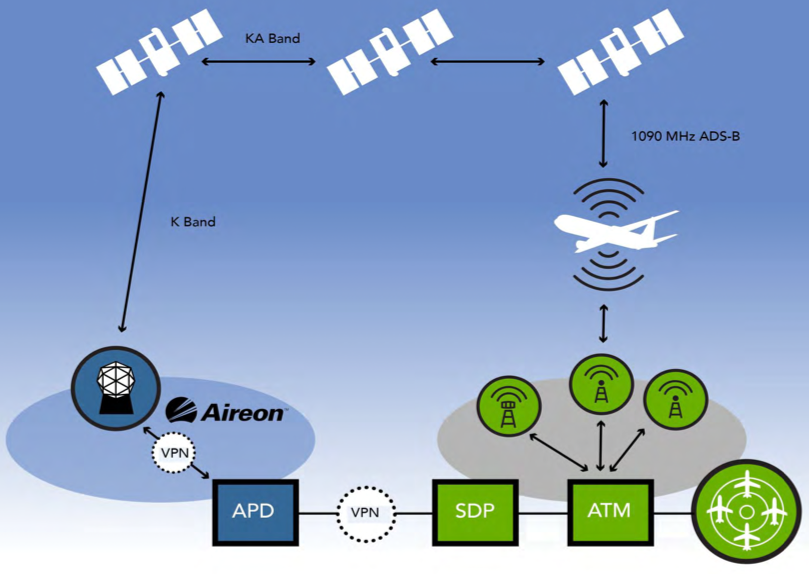 |
| Aireon Space-based ADS-B |
Friday, September 23, 2016

Wednesday, August 3, 2016
ADS-B Telemetry from EK521

Within minutes of the incident, Flightradar24.com published a time history of the ADS-B transponder transmissions from EK521.
REVISED with a closer look at the last 32 seconds and adding in position data.
REVISED with a summary plus a look at earlier arrivals wind effects
REVISED with the revelation that EK545, arriving ahead of EK521, had similar speed profile
REVISED with Boeing 777 procedures at end
Friday, June 24, 2016
Cybersecurity and Phased Arrays - PP848 and PP792
The Ku/Ka satcom subcommittee met the last two weeks to progress the latest AEEC standards and characterstics defining secure broadband connections and satcom equipment. Airbus expects to use PP848 for securing non-safety communications, bringing an unexpected urgency to completion of IPSec end-end functional definitions. PP848 will offer an optional means to segregate both passenger and non-safety aeronautical communications with a commercial broadband radio, such as Ku/Ka satcom. PP792 builds upon ARINC 791 to characterize emerging flat-panel antennas, especially phased array antennas, as well supplier-specific guidance for installing antenna systems using either 791 or PP792.


Wednesday, June 8, 2016
Aviation Data Link - Security, Segmentation, QoS
Beginning in 1978, aircraft data link emerged using a VHF network named ACARS (Aircraft Communication, Addressing and Reporting System). ACARS is a purpose-built, store-and-forward, character-based, messaging service. Within just over ten years, ACARS was extended to Inmarsat L-band satcom and HF radio. Five years later (1995) ACARS was delivering Air Traffic clearances. Today Iridium SBD (short-burst data) and even cellular radios communicate ACARS messages. How is the industry migrating to embrace and secure IP networks, and will ACARS ever go away? How are broadband radios being applied to support airplane health monitoring or EFB?
Saturday, May 21, 2016
Air Safety Investigation
 The first and foremost response to any incident is rapid rescue and for sympathy to victims, survivors, and those that loved them.
Timely alerting and accurate aircraft position is the key to rapid response.
Moving beyond rescue becomes recovery. At this point the motivation is to collect the remains of those lost and as much of the airplane itself. Assembly of the airplane parts into a skeleton gives a foundation to check and verify various failure scenarios.
Regardless of the cause of catastrophe, airplane structure and systems are designed to be fault tolerant. Crash survivability is a paramount endeavor. Materials are evaluated for their contributions to post-crash fire and smoke. While the first objective is to understand what led to the catastrophe, just as important is to understand what can be improved to enhance prevention and survivability.
Thursday, May 12, 2016
Double Secret Environmental Conditions and Test Procedures for Airborne Equipment
RTCA produces DO-160, Environmental Conditions and Test Procedures for Airborne Equipment

RTCA DO-160G Sections
Subscribe to:
Posts (Atom)